

All Research Projects
Real-Time Audiovestibular Monitoring of Acute Ménière's Disease Attacks Using Consumer Wearable Devices
Exploring Real-Time AI Captioning to Improve Communication and Accessibility for Patients with Hearing Loss
Research area
Project Leads

Yew Song Cheng, BM BCh
Med devices lead, UCSF Otolaryngology Innovation Center
Share
The Challenge: Studying a Disease That Strikes Without Warning
Ménière's disease causes unpredictable attacks of severe vertigo, hearing loss, and tinnitus. The problem with studying it is that attacks rarely happen in the clinic — meaning the disease has historically been characterized by patient recall alone, long after an episode has resolved.
A New Approach to Data Collection
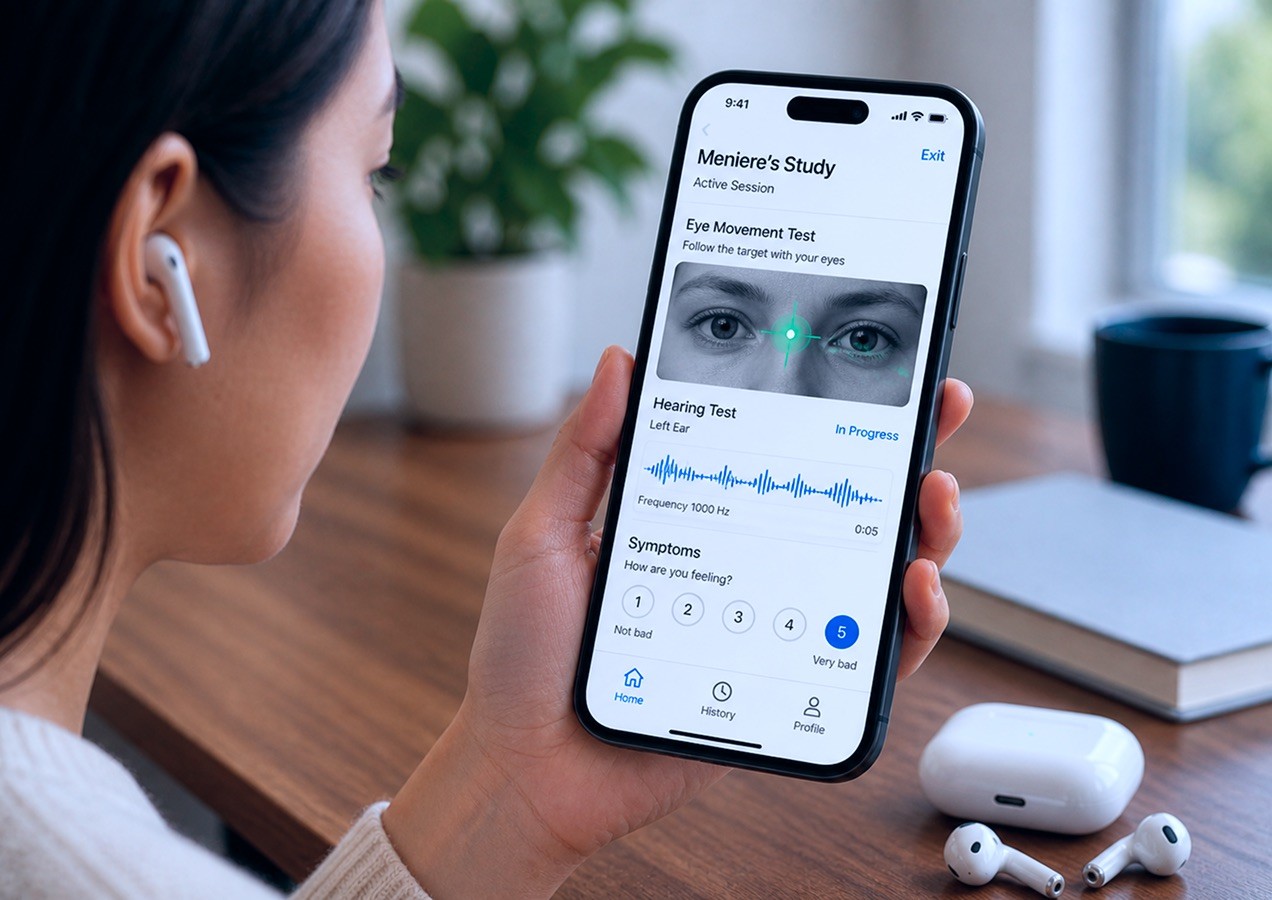
This trial deploys a novel remote monitoring platform to capture Ménière's attacks in real time. Participants use Apple AirPods to perform at-home hearing tests during an active attack, Apple Watch to track biometric and behavioral changes, and an iPhone-based eye-tracking application to record nystagmus — the involuntary eye movements that define a vertigo episode. Daily smartphone surveys capture symptoms as they evolve.
What This Makes Possible
For the first time, we can observe what actually happens to hearing, balance, and physiology during an acute attack — not days later in a clinic. This platform transforms how episodic vestibular disease can be studied, and sets a new standard for remote monitoring in otology research.
Looking Ahead
The monitoring infrastructure developed here has applications well beyond this trial — providing a reusable framework for studying any condition defined by episodic, unpredictable events.
Principal Investigator: Jeffrey Sharon MD
Co PI: Yew Song Cheng MD
" width="370.5px"/></svg>)
" width="289px"/></svg>)
